


We live in a “new world of disorder,” Stuart Eizenstat, who has served as a top policy official in three U.S. administrations, said in a keynote address at United Parcel Service Inc. the evening of Dec. 14 as he pointed to challenges from rising powers to the south and east as well as events plaguing headlines with news of terrorism, climate change and cybercrime.
He called globalization and an interconnected world “a huge positive for the U.S.,” but admitted that it has “a dark side.”
On the upside, Africans in rural villages can take online courses from the Massachusetts Institute of Technology,” he said.
Yet the global reach of cybercrime, which has been enabled by the profusion of new technologies, is definitely a negative, he added, admitting that his own profile including his Social Security number “and everything else” is in China’s hands due to a successful hack attack.
He also provided a spirited defense of the nuclear development agreement reached with Iran as an imperative to deal with the “greatest near term threat” that the U.S. faces, namely “the ayatollahs with nuclear weapons.”
Aside from the ability to have “24/7” inspections of Iran’s nuclear plants, he said the agreement provides “for time to bring Iran around.” And if the Iranian government cheats on the agreement, “We will provide our allies with all the arms that they need to defend themselves.”

Mr. Eizenstat’s address was the last official program of Cedric Suzman, who for almost 40 years has been organizing and promoting speaker programs of this sort on behalf of the Southern Center for International Studies and the World Affairs Council of Atlanta.
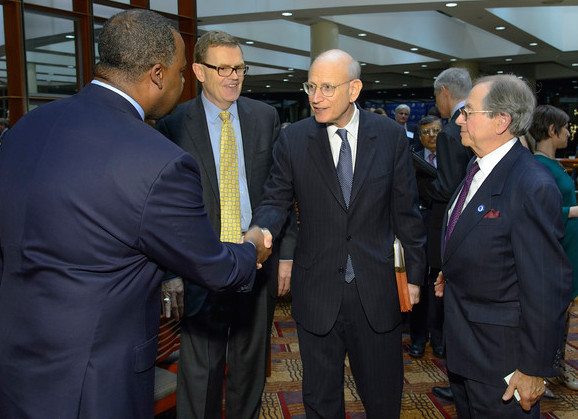
Speaking at Dr. Suzman’s retirement dinner, which was attended by 230 academic, business, civic officials and family and friends, Mr. Eizenstat provided a panoramic view of the perils facing the U.S.
But he refused to despair and called for the U.S. to meet the many challenges it faces with optimism in its capabilities and hope for a better world.
Currently head of the international practice of the prestigious Washington-based law firm Covington and Burling LLP, Mr. Eizenstat retains a catbird position on world affairs that he has held for more than a decade and a half of public service in the Carter, Clinton and Obama administrations. He holds the official designation of ambassador for having served as the U.S. ambassador to the European Union from 1993-96.
An Atlanta native, Mr. Eizenstat reminisced about his days here when he was “weened on Coke” and then traced the profound changes that have engaged the U.S. since the end of World War II when it played a determining role in establishing the postwar order.

“Now its leadership is challenged in every field” he said of the U.S. and described the rise of China as an economic power with the world’s largest super conductor and has become, he added, the leading manufacturer of steel, solar panels and wind turbines.
He quipped that China even has taken from Italy its top ranking as leading producer of violins.
He also pointed to China’s new development bank that is to compete with the World Bank and its ambitions in the China Sea where it is transforming coral atolls into islands that can support landing strips.
Yet China is far from being alone, he said, in assuming new roles in the world order. “There is a multiplicity of countries that want their day in the sun,” he added, pointing to the “Asian tigers,” and Turkey, “which are all elevating at the same time.”
“We have to do things in coalitions,” he said in view of these rising powers. “We can’t just snap our fingers.”

This new order is “not catastrophic” for the U.S., he said. “We are not a beached whale,” he added, pointing to the country’s “unique capacity for innovation.”
Nor is China at the top of the list of U.S. challenges, according to Mr. Eizenstat, who sees potential for collaboration with the 100,000 Chinese currently studying in the U.S., including the children and grandchildren of members of the Chinese politburo.
He also cited the interconnectedness of U.S.-China trade. “If the global supply chain breaks down, China suffers. We’re all in this together. There is a remarkable interdependency.”
“We tend to see China as sort of an absolute super power,” he added, “but the fact is China has its share of problems.” “I wouldn’t trade our situation for theirs,” he said, citing the U.S.’s multiethnic population as ideal for participating in a more globalized world.
The U.S. also benefits from greater energy independence due to the discovery of oil and natural gas reserves through fracking, he said, releasing it from the stranglehold on energy supplies of the Organization of the Petroleum Exporting Countries (OPEC).
Before ending his address with a prescription on how to deal with terrorist threats, he discussed what he considers a “lightyear’s change” in the attitude of countries such as China and India to the policies regarding climate change.

He recalled that when he was negotiating climate issues in Kyoto, Japan, in 1997, the developing countries insisted that the U.S. and other developed nations were the source of the problem and that it was their responsibility to adopt stricter regulations.
But during the recent Paris climate conference, he noticed “a lightyear’s change in that attitude” as China faced a red alert for the first time forcing the closing of schools in Beijing and halting outdoor construction due to the poor air quality.
The change of attitude towards adopting climate related policies in China and elsewhere provides a far better opportunity for cooperation than when he was negotiating in the 1990s, he said.
Finally, he addressed terrorism, fully accepting the seriousness of the challenge and cited estimates that France now had 1,000 French back home after having been radicalized in the Middle East, and that the U.S. may have as many as 100 Americans fighting in Iraq and Syria.
Acknowledging anti-trade and anti-immigrant rhetoric as a direct result of the terrorist attacks in France, the U.S. and elsewhere, he cited the ripple effect of these incidents changing the politics of Western nations by fueling right wing parties.
He warned against adopting an attitude of “a war of civilizations” as described by the American political scientist Samuel Huntington pitting Muslims against the West.
“There are those who want to join the globalized world and those that want to destroy it,” he said. “We mustn’t lump the two together.”

In conclusion, he proposed a set of pragmatic solutions to combat terrorism, including beefing up European intelligence capabilities, stopping imams in Saudi Arabia and Qatar from promulgating a “Wahhabi” brand of Islam, increasing the frequency of airstrikes to dismantle the ISIS (Islamic State of Iraq and al-Sham) infrastructure in Syria and Iraq, increasing support for moderates fighting ISIS forces, establishing safe havens for refugees with “no fly zones,” breaking up the financial base from which ISIS operates, and shutting down social media cites supporting ISIS.
He repeatedly referred to moderate Muslims who vastly outnumber the terrorists, and pointed to recent gains by the Iraqi army, which is reclaiming territories that had been overtaken by ISIS.
“We have the will, capacity and resources,” he said to combat the terrorists. “But the greatest threat is our polarization politically.”
Without naming names, he called for political candidates that “can unite the country.”
For another Global Atlanta article on Dr. Suzman’s retirement dinner, click here.

The Dean Rusk International Law Center at the University of Georgia is the presenting sponsor of Global Atlanta's Diplomacy Channel. Subscribe here for monthly Diplomacy newsletters.