


Green Worldwide Shipping is the presenting sponsor of Global Atlanta's Trade Channel. Sign up here for monthly global trade updates.
There were no simple how-tos, no trite guarantees of success — just stories of the real risks and rewards of doing business in the trenches of the international marketplace.
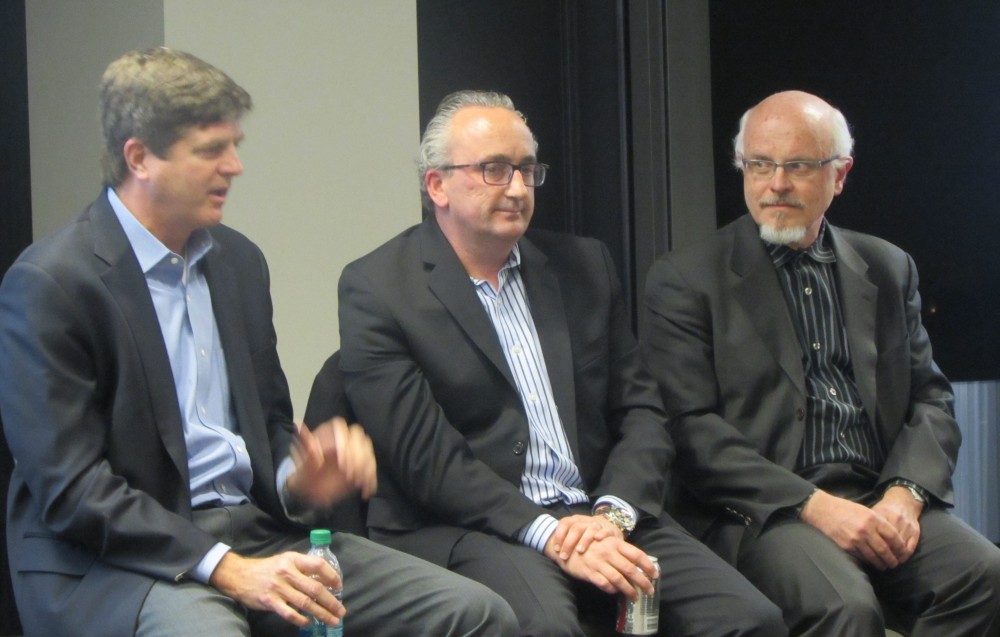
That was the backdrop for three metro Atlanta companies whose executives shared their experiences Jan. 21 at Global Atlanta’s second annual Export Stories special report preview, sponsored by the Atlanta Metro Export Plan and hosted at Burr & Forman LLP.
As Atlanta seeks to raise its international profile, the Atlanta MEP is encouraging companies to create strategies for international sales — and putting its money where its mouth is. Backed with $210,000 from JPMorgan Chase, the MEP announced 35 winners of $5,000 reimbursement grants at the event, which was attended by more than 80 people, including many existing and aspiring exporters.
Business beyond U.S. borders isn’t easy, but it’s achievable and rewarding with the right balance of caution and ambition, according to panelists whose industries ranged from a boutique design firm to a diaper factory filtration company.
Jan Lorenc, principal of Lorenc+Yoo design, said his Roswell-based firm has had to stay on firm financial footing in the U.S. so it doesn’t chase bad international deals, where the scope of projects often get expanded without a corresponding rise in compensation. Front-loading his fees has been essential, and the hassle has been worth it: the company has been able to work with some of China’s largest developers on ambitious projects like the recent one rounding out its portfolio, a replica Swiss city of Lucerne in China’s interior.
“There are not too many clients in the U.S. asking us to design a city,” said Mr. Lorenc, who was nonetheless very clear about the fact that a designer’s vision for a project isn’t always how it turns out in China, where construction and developers often work from design concepts rather than pay for scaled drawings.
To get paid, David Ankenbrandt does business on the condition that customers qualify letters of credit, bank guarantees that sellers will receive their funds in the event of non-payment. Osprey Corp., which sells filtration systems for baby diaper factories, has clients all over the world from Italy to India. While the company often sells directly to consumer-products giants based in the U.S. with factories elsewhere, it doesn’t turn its nose up at smaller customers in far-flung locales. Instead, Mr. Ankenbrandt, the CEO, takes a relational approach that has been uniquely rewarding.
“Being able to do business internationally has enriched my life,” said Mr. Ankenbrandt, who noted that his willingness to get on a plane has won both the hospitality and gratitude of midsized company executives in places like Algeria.
Face-to-face is the only way to do serious business, especially in emerging markets where the back-end business infrastructure taken for granted in the U.S. — things like reliable power supply and online ordering — isn’t well developed, said Bart Verbeke, a Belgium native who has worked all over Africa with Alpharetta-based mining supply company Citland International.
Citland works with multinational mining companies so is able to protect its sales with private export insurance, but the company hasn’t been able to take its position in the market for granted. Citland has opened warehouses in places like Ghana and Burkina Faso to keep spare parts close to customers, even taking on the risk of managing supply chains for the mines, a relatively new service.
“If you’re not evolving and providing services, then you’re going to die in this industry. The world is getting more globalized and supply chains more integrated every day,” Mr. Verbeke said.
That reality was reflected in a survey released at the event by Habif, Arogeti & Wynne LLP, an Atlanta CPA firm with 28 languages spoken on staff. Yelena Epova, partner-in-charge of international services, said the survey of more than 120 Georgia exporters conducted in partnership with Global Atlanta and the Georgia State University Center for International Business Education and Research showed that while exporters face headwinds in the form of currency fluctuation and uncertainty about forging international partnerships, 64 percent said the value of their exports had increased over the last five years and more than half planned to sell to a new country in 2015.
Still, there was a disconnect in what companies saw as their biggest potential export boosters — tax incentives — and their knowledge of those already available. Less than 30 percent, for example, knew about the IC-DISC, a tax structure that helps companies save on taxes from export sales, and even fewer had considered moving their intellectual property offshore, another way to lower your tax bill.
“Transfer pricing policies, IC-DISC, tax structuring and other incentives can produce a substantial reduction in international tax, protect exporters from exposure and increase the overall benefit a company receives from exporting,” Yelena Epova, partner-in-charge of international services, said in the report. “Exporters and potential exporters should make sure that they are investigating these options so that no money is being left on the table.”
After the panel, Ric Hubler, the Metro Atlanta Chamber’s senior director of global business development, announced the 35 grant winners for the first time, showing considerable skill in explaining their varied products and services, from stylish-yet-comfortable Foxers lingerie to Gimme, a Georgia Tech-launched startup using software to help vending machine firms better manage their stock with real-time data, to Vayando, another startup that connects travelers with small-scale entrepreneurs in places like Costa Rica and Rwanda to provide authentic local travel experiences. Many company representatives were in attendance to gain knowledge that will help with the export plans they submitted to the MEP to win the grant. Global Atlanta will include some in its Export Stories report and will follow the progress of others.
Click here to see the full list of grant winners, who form the pool that will compete later for even bigger prize money.
Learn more about the Atlanta MEP’s Export Challenge at www.atlantaexportportal.com.