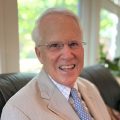
Former President Jimmy Carter’s openness and philosophical attitude about having brain cancer reminds him of the Rev. Martin Luther King Jr.’s attitude toward death, Andrew Young told a Kiwanis Club of Atlanta luncheon Aug. 25 during which he also reviewed Atlanta’s growth as a global commercial center and discussed the upcoming presidential election.
Mr. Young said that Ralph Bunche, the first African American diplomat and Nobel Prize winner, had warned Dr. King about how his protest against the Vietnam War increased the possibility of assassination, which already was high because of his efforts on behalf of the civil rights movement.
But such concerns didn’t seem to affect Dr. King who would “make us laugh at the possibility of death,” Mr. Young said adding that the year before he was shot down in Memphis, Tenn., the civil rights leader had turned down an opportunity to preach at the Riverside Church in New York and teach at the Union Theological Seminary as a form of sabbatical from leading the movement.
“In his personal and casual life he would be cracking jokes — mostly about preachers — and was a lot of fun to be around when people started getting nervous about the dangers of our work,” he added.
“If you take a bullet for me, I think I can preach you in heaven,” Dr. King would say, according to Mr. Young, who then would have to listen to Dr. King’s eulogy for him during which he would recount “every embarrassing thing that he ever knew about me and then he’d make some up.”
Having begun reading Mr. Carter’s latest book, “A Full Life, Reflections at Ninety,” the night before, Mr. Young said that the former president was a product of hard times for whites as well as blacks in rural Georgia and that through his military service Mr. Carter knew “how hard war could be.”
“He was determined to keep the world peaceful,” he added.
As executive director of the Southern Christian Leadership Conference, Mr. Young became one of Dr. King’s principal lieutenants. He served in the U.S. Congress and was appointed by Mr. Carter in 1977 to serve as the U.S. ambassador to the United Nations.
He went on to serve as Atlanta’s mayor and then has had a business career and heads the Andrew Young Foundation.
“We are over programed with the world’s problems,” he said at the beginning of his talk criticizing the 24-hour news cycle and negative reporting from around the world that has engendered anxiety in everyone’s lives.
“Our greatest threat is cynicism because we are bombarded by so many problems — everyday, every morning we hear that nothing good is happening in the world.”
His point wasn’t that there isn’t plenty to be concerned about, but that the pace of modern life has removed the ability for the world’s leaders to properly assess what needs to be done and then to relay with confidence what has to be done.
He referred to the onset of World War II when the U.S. faced the threat of German U-boats off its coast, then-President Franklin D. Roosevelt visited the Caribbean, taking his time to prepare for a proper response to British pleas for war materiel resulting in the Lend-Lease program and the end of a U.S. policy of neutrality.
“Roosevelt had time to think through the problems of the world, and I don’t know that we are as bad off now as we were in the 1940s,” he added.
On a positive note, he pointed to Atlanta’s growth as a global center with the expansion of educational and commercial opportunities for its 6.5 million population, although he qualified his enthusiasm saying that the city is ideally suited to handle a smaller population of 2 million.
He said that he had confidence in the youth that he has met in many of the 152 countries which he has visited, and he added that Atlanta would benefit in the future due to its multiethnic population.
He also cited the growth of wealth around the world, but lamented that a reportedly $50 trillion is being kept in tax havens due to a fear for the future. And he cited the creation of jobs for the world’s growing population as the biggest challenge facing the future both here at home and abroad.
In the course of his talk he quoted the lines from Proverbs, “Where there is no vision, the people perish,” and recounted the efforts of Atlanta’s past civic leaders to create the conditions for the city’s growth. But even former mayors, William Hartsfield and Ivan Allen, who planned for the current growth, he said, would be astounded by Atlanta’s size today.
After recounting the progressive moves of these and other past city leaders, he was asked who he thinks are today’s visionaries and what are the policies that will make for progress.
In his response he focused on the upcoming election for president as revealing the problems faced by leaders everywhere. “I don’t know who they are,” he replied. “The election is trying to take us back to a time when things were safe and secure, but we just don’t go back.”
While confessing that he personally also didn’t have “a clear vision of where we are going,” he included most politicians are in a similar state of confusion. “What is taking us forward is not politics, but it’s technology.”
In a global economy, a cellphone can transfer huge amounts of money or a reevaluation of the Chinese currency can have a profound impact with tremendous implications for countries around the world, he added decrying that such issues are not being addressed by the presidential candidates.
Meanwhile, the candidates, he said, are struggling for attention, citing Donald Trump’s call for constructing a wall between the U.S. and Mexico.
If built by Mexicans, he added, it would have an “air conditioned tunnel” built underneath similar to the one used by drug kingpin Joaquin “El Chapo” Guzman to escape from a maximum-security prison.
To hear the audio of Mr. Young’s speech, click here. To learn more about Kiwanis Club of Atlanta events, click here.

GSU-CIBER is the presenting sponsor of Global Atlanta's Education Channel. Subscribe here for monthly Education newsletters.