


During my first trip to Dublin, while most of my fellow Georgia State University students dozed on the bus ride from the airport to our hotel, I kept my eyes wide open and my face pressed against the window.

My excitement grew as our bus turned down O’Connell Street and passed the General Post Office, or GPO, from which Patrick Henry Pearse read the Proclamation of the Irish Republic during the 1916 Easter Rising, an unsuccessful rebellion against the British Empire.
As we toured Dublin on foot my companions grew increasingly aware that we had hit on a near-obsession of mine; as a history student as I had written my undergraduate thesis on the failed republican rebellion of Easter 1916.
The city had changed so little that the historical maps I had pored over to the point of near memorization were still useful.
As we neared St. Stephen’s Green I was surprised to see that the Shelbourne Hotel, which had been occupied by British Army soldiers during the Rising, looked almost exactly the same as in the 90-year-old pictures I had seen in history books. There are still bullet holes visible on the side of the arch in St. Stephen’s Green and the façade of the Royal College of Surgeons, both of which had been occupied by rebels and riddled by a machine gun stationed on the hotel roof.
Over the next few days I immersed myself in a history that I had only hitherto experienced through books. I visited Trinity College, the Four Courts, the site of Liberty Hall, and Dublin Castle; all of which have histories and significance beyond the Easter Rising but which I especially wanted to see due to their connections to those events.
Historical debates and controversies arising from 1916 often do not leave the realm of academics, but as this year marks the Rising’s centenary, thousands of people around the world have become interested in the topic.
Of course, Irish interest has never waned. During another visit to Dublin in 2014 I had an opportunity to tour Leinster House, the site of Ireland’s legislature, the Oireachtas. Upon exiting I was given a copy of the 1916 Proclamation, which brought home the fact that the Rising is considered the spark that began a long chain of events resulting in today’s Republic of Ireland.
During my most recent trip to Dublin in January I made a point to visit Moore Street near the GPO, the site of the final rebel headquarters before their surrender. Just a week before my arrival protesters occupied the row of buildings for several days to demonstrate against plans to demolish the buildings to make way for a shopping complex.
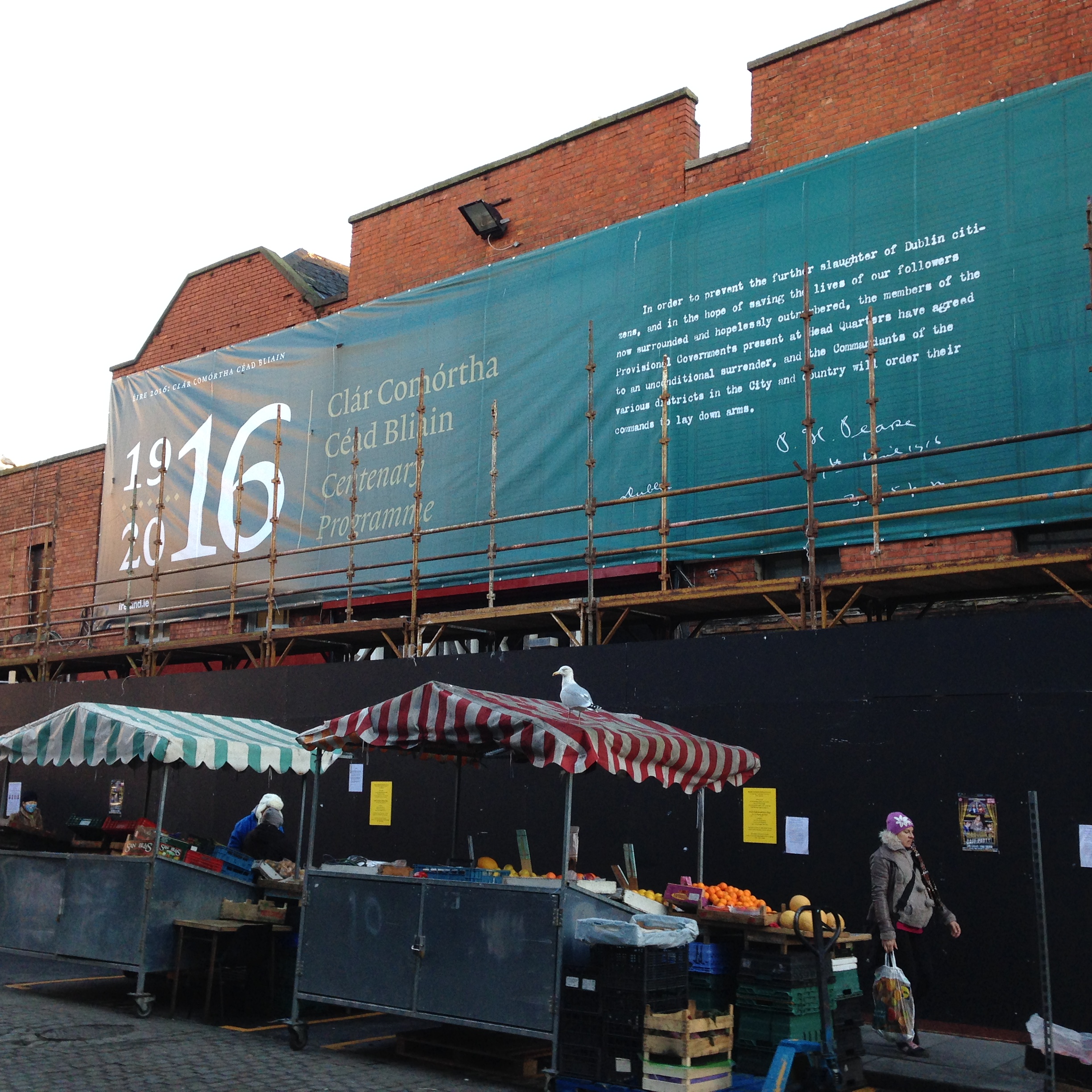
Moore Street was empty by the time I arrived. An ensuing court battle decided the issue on March 18—the day after St. Patrick’s Day—by declaring the site a national monument.
Not everyone in today’s Republic agrees that the Easter Rising and its originators are worthy of the elevated status they enjoy in Irish society. Those holding this view emphasize that it was a violent insurrection by a small clique, whose public support was likely minimal at its outset.
Critics of 1916 celebrations argue that they encourage people to support violent solutions to political problems. Phrases within the Proclamation of the Republic, particularly those relating to women’s rights and economic equality, cause some to question whether today’s state fulfills the vision of those who sparked the rebellion.
Historians have long parsed these issues among themselves and, given the prominence of the 1916 centenary, they have recently been joined by politicians, journalists and members of the public.
Commemorations of the Easter Rising are perhaps most sensitive in Northern Ireland, where a civil conflict between republicans and unionists, the latter of whom wish to maintain their political connection to the United Kingdom, lasted from the late 1960s until 1998.
Northern Ireland’s First Minister Arlene Foster traveled to Dublin in February for a public talk on the Rising and its legacy given by a number of historians. This was significant as Ms. Foster is a member of the Democratic Unionist Party and would have been expected to shun such gatherings in the past. She was careful to explain that she was attending a 1916 “event” not a “commemoration.”
The events of the Easter Rising strike a chord with people all over the world due to their undeniable drama. For many, remembering those events provides an opportunity to celebrate the Rising’s idealism and the eventual emergence of an Irish state.
Commemorations of this failed rebellion spark controversy in some quarters because they raise fundamental issues as to the nature of that state, including its violent birth and its accompaniment with the partition of the island into northern and southern political entities.
The fact that Irish society provides ample space to both viewpoints is a testament to its strength and openness.
For historians, the Rising centenary celebrations mark a convergence of their academic interests with passionate public outpourings. One of the things that drew me to Irish history is that so many people have a profound interest in the subject and its impact on the present. The Rising centenary provides strong evidence of that passion.
M. C. Rast is a Ph.D. candidate in Irish history at Concordia University, Montreal, Canada. He earned his M.A. at Georgia State University and is a former Global Atlanta reporter.

GSU-CIBER is the presenting sponsor of Global Atlanta's Education Channel. Subscribe here for monthly Education newsletters.

Atlanta Ballet is the presenting sponsor of Global Atlanta's Culture Channel. Subscribe here for monthly Culture newsletters.