


Despite a deep political scandal that has toppled a president and given Brazil’s reputation a black eye, the country’s farms and slaughterhouses have continued doing what they do best: growing, harvesting and selling agricultural commodities on a global scale.
That was the message of a Brazilian delegation occupying a large pavilion at this year’s International Production and Processing Expo in Atlanta, which brings together many of the world’s biggest makers of equipment and other products for the raising and slaughter of “proteins” like chicken and pork.
It’s held annually in the backyard of one of the biggest poultry-producing regions in the world — the Southeast U.S.
North Georgia is a hotbed in the sector, with millions of “broilers” — the industry term for whole chickens — produced here every year for domestic consumption and export.
But even though major local companies in sectors like animal health, food packaging and feed equipment can be readily found at the Georgia World Congress Center, the event is a decidedly global affair. Walking the exhibit halls, one can hear languages like Spanish, Dutch, Portuguese, Mandarin Chinese and others in short order.
Amid all this, Brazil needed a way to stand out. For the second straight year, the government brought nearly 20 companies to camp out under yellow haloed banners labeled “Brasil,” beckoning lanyard-clad attendees to learn more about the country.
In addition to small white booths surrounding the pavilion, companies could entertain clients in its spacious. cafe-style seating area.
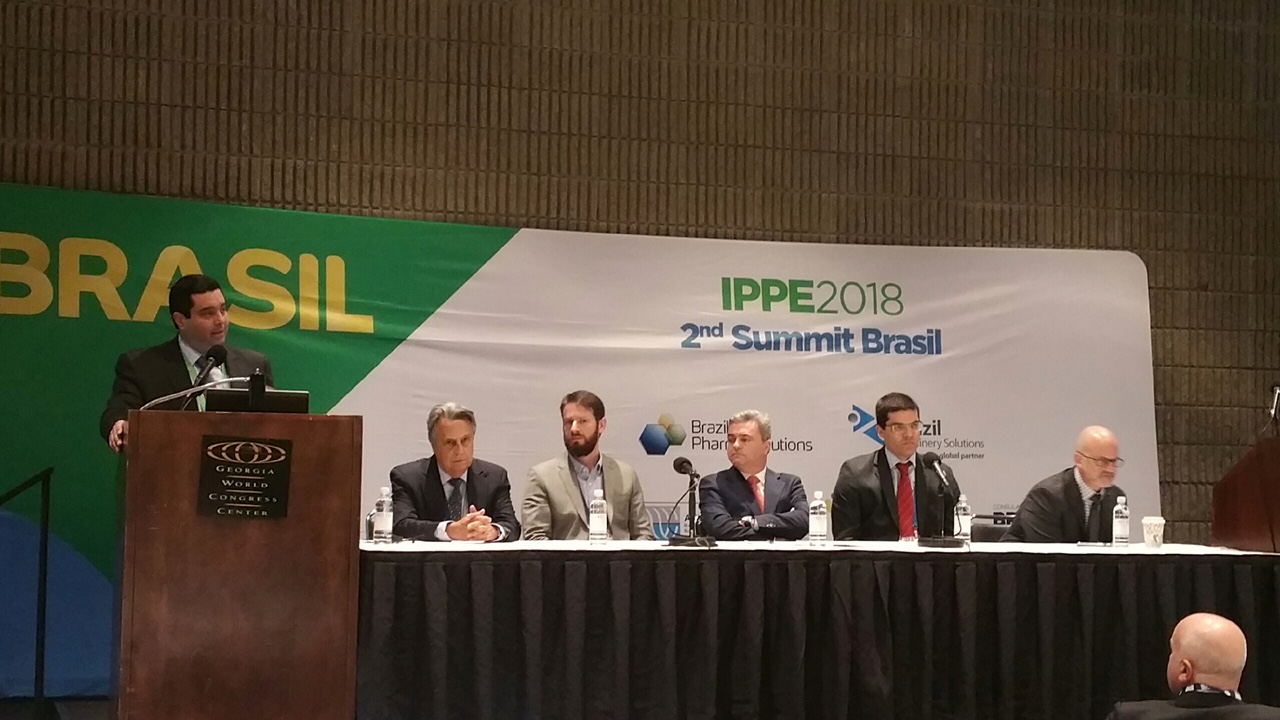
Egbert Ferreira, Brazil’s new deputy consul for trade and investment at the Consulate General of Brazil in Atlanta, told Global Atlanta that the decision to band together was a matter of getting the most bang for the country’s buck.
“I believe we get more visibility if we join forces,” Mr. Ferreira said after a Brazil-focused breakfast event, noting that Brazilian producers spread throughout the show might’ve otherwise been subsumed by the sea of competition.
Agricultural production has mainly been a bright spot for the Brazilian economy, a long-standing and resilient sector whose success hasn’t been tied to government funding — now in short supply amid a clampdown on federal spending, Mr. Ferreira said.
Agribusiness was what “held the Brazilian economy together” over the last few years, he added.
Indeed, Brazilian firms are among the most sophisticated and in the world when it comes to crop and protein production. As one example, U.S.-based Pilgrim’s Pride, which has many poultry facilities in Georgia, is now 75 percent owned by Brazil’s JBS, a massive company that ranks among the top food companies in the world.
Brazil’s economy is now “decoupling” from its political uncertainty, with growth projected to return this year despite another looming presidential election, said Fernando Spohl, operations manager at the North American office of Apex-Brasil in Miami, which supports the country’s exports and promotes inbound investment.
The consistency of food producers and related agricultural industries like biomass and renewable energies, animal pharmaceuticals and other segments has been a big part of that story, he said.
“Brazilians adapt very well. Brazilian entrepreneurs and executives, they’re heroes sometimes because they really work hard,” Mr. Spohr said of companies that plowed ahead despite the fragile economy.
Brazil remains the second largest poultry producers and top poultry exporter world, accounting for 36 percent of the world’s market share for exported chicken, said Ricardo Santin, the market-access vice president for the Brazilian Animal Protein Association, during the breakfast.
Of course, the story hasn’t been all positive: Exports plummeted after March 2017, when the Brazilian federal police launched an investigation into slaughterhouses that had allegedly bribed food inspectors in a sting known as “Operation Weak Flesh.”
The resulting backlash led many countries from the EU to China to close their borders to meat from Brazil, the top exporter of chicken and beef. Mr. Santin said that reaction was disproportionate to the threat, given that none of the implicated facilities were involved in exportation of meat.
He said the problem was more of a publicity issue and that all countries that had closed their borders to Brazilian poultry have since conducted their own inspections and reopened their borders.
Brazil is an “island” of sanitary conditions that has yet to see an outbreak of avian influenza, he said with a note of pride (but also jokingly knocking on the wood of the podium.)
With the world population projected to mushroom to 9 billion by 2050 and Brazil currently utilizing only 9 percent of its arable land, the country will play a major role in feeding the world in the future, making it a good bet for agricultural investment, Mr. Santin said,

“(Poultry and pork) are very rooted sectors in our economy. This is not a eventual business or temporary business,” Mr. Santin said.
Over the last 40 years, Brazil has exported 60 million tons of chicken to 203 countries, contributing $94 billion to the country’s economy, according to figures from the association.
“It is not possible if you don’t have a strong chain of production,” he said.
Some showcase Brazilian companies were also keen to put themselves on the map through the show.
Farmabase, a major provider of poultry and pork pharmaceutical products, had a large exhibition booth next to the Brazil pavilion. Fresh off acquiring Cevasa, an Argentina-based firm, the company was looking to establish more global partnerships.
“IPPE is always a meeting we have in our schedule,” Vitor Franceschini, sales director, said at the Brazil breakfast.
Biocamp Laboratórios, meanwhile, was bent on promoting its probiotics, “good” bacteria that can be ingested or even injected into chicken eggs before hatching.
With a rising consumer preferences for chicken raised without antibiotics, producers need to get ahead of illnesses as early as possible, said Paulo Martins, a veterinarian for Biocamp. The company’s new slogan: “For a world more pro and less anti.”
Learn more about Brazilian companies exhibiting at the pavilion here.

