


Market Access International is the presenting sponsor of Global Atlanta's Canada Channel. Subscribe here for monthly Canada newsletters.
MONTREAL — Walk through Lion Electric’s flagship factory in Saint-Jerome, just outside Montreal, and it’s clear that production is in no danger of being paralyzed by supply-chain worries.
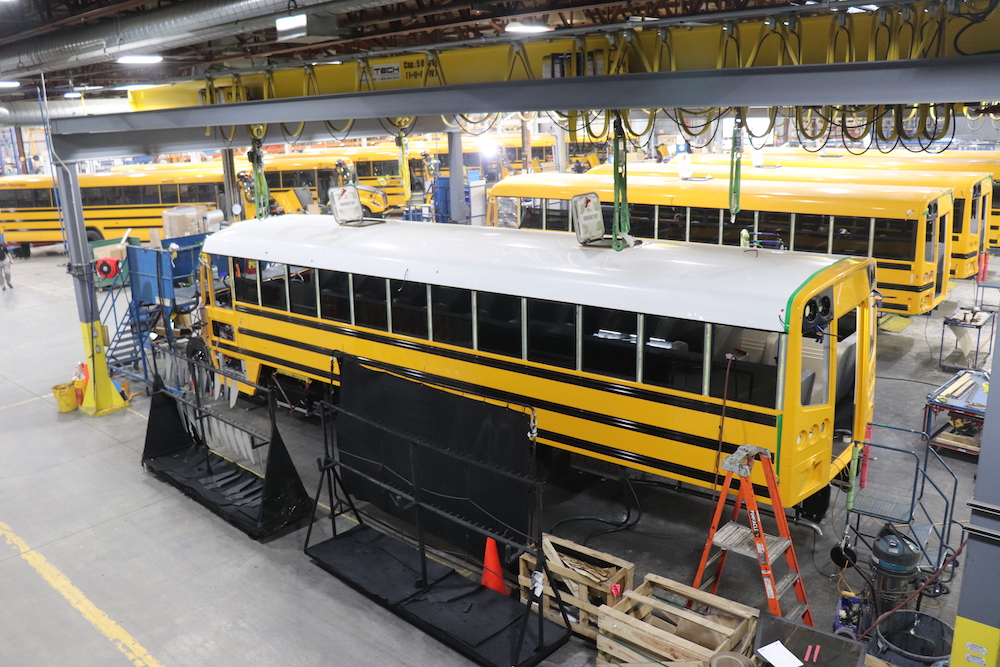
Yellow school buses move laterally down a line where workers outfit LION’s signature composite bodies with seats, electronics, stairs and seatbelts before being mounted atop a proprietary electrified chassis. A few steps away, workers perform checks on separate truck chassis that will power the class-6 and class-8 electric delivery trucks used by the likes of IKEA and Amazon.
During a Global Atlanta tour of the facility in April, Vice President of Marketing Patrick Gervais indicated that Lion, which executives call “an overnight success 13 years in the making,” is avoiding some challenges stymying production in many other sectors.
“We’re not going to run out of batteries,” he said, pointing to the ample stock on the factory floor. “We’re good for a very long time.”
It’s not quite as simple as saying this is because Quebec has indigenized all facets of electric-vehicle production, but that is part of the story.
The Canadian province has embarked on a strategic effort to vertically integrate the supply chain in future-facing fleet vehicles, and the world is taking notice of its blend of baseline advantages and targeted ambition.
With aggressive provincial government policy, national backing, access to key minerals, strong academic research and plentiful, cheap and clean hydroelectricity, Quebec is a laboratory for the world’s transition to battery-powered mobility. If it doesn’t work here, it may not work anywhere; it’s still early days, but signs that the shift is inexorable are emerging, with potential benefits for the U.S., the biggest market for Canadian firms.
Take those batteries, for instance: LION is building a $185 million plant in Quebec to produce its own by 2023, a bid to control the technology that still makes up a large proportion of the vehicle’s final cost. The Quebec and national governments are kicking in $50 million each, down payments on their respective strategies to foster supply-chain independence and support green-energy and circular-economy transitions.
LION founder and CEO Marc Bedard made the decision to go all-electric way back in 2011, just three years after the company’s founding.
“He said we’re going to go 100 percent electric, and everyone said,
‘You’re crazy,’” Mr. Gervais, the marketing VP, told Global Atlanta during an interview at his office.
Till then, LION — the name chosen to resonate with chest-thumping executives and end users (children) alike — had made its mark mainly by using a composite material that would rust less than metal in Quebec’s harsh winters. LION also widened the standard wheel base so that each seat could have a three-point seatbelt, and it began selling well in the few states, like California, where those are required. Its first electric bus hit the road in Massachusetts in 2016, a novelty geared toward early adopters at the time.
“In 2016, when you were purchasing 100 percent electric school bus, you were doing it for the environment, as a gesture saying, ‘Hey, you know what? I think this is the future, I’m getting one and getting used to it,’” Mr. Gervais said. “But in the next couple of years, it all changed and it became a viable business model because of the total cost of ownership.”
While a larger upfront investment, LION estimates that each electric bus saves 80 percent on fuel costs and 60 percent on maintenance versus diesel. School buses are ideal for electrification, Mr. Gervais said, because they run on standard routes and return back to base (a charging depot) every day. With the technology now available, “there’s no excuse not to go electric.”
“Everything that does 255 miles or less, for me should be all electric,” he said.
So far, 600 LION buses have driven 10 million miles on North American roads, but the company is planning a massive ramp-up. LION will soon commission a factory in Joliet, Ill., that can produce 20,000 vehicles a year for the U.S. market, where “Buy American” provisions for federally funded transportation projects mean a majority of the content has to be produced in-country.
Mr. Gerard, the founder, joined U.S. Vice President Kamala Harris in Virginia May 23 when she announced a $5 billion EPA initiative to electrify school buses with funding from the recently passed bipartisan infrastructure bill. The program awards up to $375,000 per zero-emission bus deployed. (Lion delivered 84 vehicles and had net earnings of $2.1 million in the first quarter of 2022 on $22.6 million in revenue — it has an order book of 2,422 all-electric vehicles valued at an estimated $600 million).
LION’s ambition matches the scale of the problem: Just 1 percent of buses and heavy-duty trucks are zero-emission vehicles, CEO Mr. Bedard wrote in a recent article, while the International Energy Agency estimates that 79 percent and 59 percent, respectively, need to make the transition by 2050 in order for the world to reach net-zero emissions.
To help school districts get over the inevitable electric learning curve, LION has dedicated units to help them select the best charging infrastructure and work directly with power utilities. A telematics system allows LION’s teams in Canada to monitor the buses remotely for potential performance issues, and groups of technicians known as BrightSquads provide on-the-spot service. In the U.S., this has led to an Atlanta connection: Cox Automotive has mobile units that are approved to offer LION service across the country, Mr. Gervais said.
As LION’s experience shows, sparking an electric revolution is not as simple as just offering a capable product. The whole ecosystem has to change, from infrastructure like charging stations to the way that municipalities think about their procurement processes.
Quebec has made an ambitious start: The province has committed to electrifying 55 percent of city buses and 65 percent of school buses by 2030, in line with its climate goals, but bus buyers tend to move more gradually, says Emmanuelle Toussaint, vice president of legal, regulatory and public affairs at Nova Bus, which manufactures diesel, CNG and electric transit buses.
“They cannot just switch from one day to the other,” Ms. Toussaint told Global Atlanta during an interview at Nova Bus’s Saint-Eustache factory, a little closer to Montreal.
It can sometimes take more years for cities and transit authorities to upgrade garages or parking lots with the charging stations they need to support electric buses, and authorities are usually replacing about 10 percent of their fleets per year. In Atlanta, MARTA commissioned its first three electric buses — made by New Flyer in Winnipeg, Canada.
“We have many cities themselves who ask why it’s not faster, and we always say, the buses — they come at the end. It’s really at the end of the equation,” Ms. Toussaint said.
That hasn’t dampened Nova Bus’s enthusiasm for its all-electric LFSe+ model, which recently won an order for 24 buses from four Quebec transit authorities.
Owned by Sweden’s Volvo Group, the Nova Bus is in the midst of a $250 million transformation plan to drive innovation, including greater commitment to electrification to meet the expected upswing in demand. For now, electric buses are about 1 percent of the deployed transit buses in North America.
“It’s still a very small portion, but it will change, and we see that in the next 10 years it will be really dominated by electric buses,” Ms. Toussaint said.
In the meantime, having a full suite of powertrain options — and a U.S. facility in Plattsburgh, N.Y. — is key to winning tenders across North America, where about 6,000 transit buses are replaced each year (five out of six of them in the U.S.)


Quebec’s Light Bulb Moment
What might be described as Quebec’s light bulb moment came years ago when the province saw that it had all the assets necessary to build an end-to-end electric mobility cluster — at least when it came to fleets. (Quebec has no passenger vehicle industry to speak of, having ceded that to Ontario).
Benoit Montreuil, a chaired Georgia Tech supply-chain professor who hails from Quebec and studies what he calls the “physical Internet,” researched this during his years at Universite Laval in Quebec City.
What stood out at first was the cheap hydroelectricity from the St. Lawrence River that has powered standout performance in energy-intensive industries. Having a virtually limitless renewable source enables a truly green transition, instead of just moving emissions around.
“There is so much hydro power that is available that it would be a shame not to leverage it from the economic and social development perspectives,” Dr. Montreuil said the research team concluded.
Beyond that, he said, the expertise developed at the utility Hydro-Quebec over 80 years of power-generation leadership has created direct impacts and spillover effects at local universities, leading to expertise in batteries, energy transmission, motors and more. The company counts 500 engineers, scientists and technicians pooling their expertise in support of its business units.
“Hydroelectricity, it’s been in our blood, just like hockey if I could say so — the reflexes of our businesspeople have this in mind,” said LION’s Mr. Gervais.
LION is a perfect example of how that can work to companies’
benefit: Its own electric motor was developed by Hydro-Quebec’s research arm, IREQ. The utility commercialized the motor through a joint venture with American firm Dana Inc.
Dana TM4, based in Boucherville, is still 45 percent owned by Hydro-Quebec after an $85 million recapitalization in 2019. Dana TM4 first made inroads with Chinese bus companies and now is powering the growth of LION and other innovators.
During an interview at his office in Montreal, Hubert Bolduc, president of Investissement Quebec International, motioned out the window to Hydro-Quebec’s headquarters building, emblazoned with an orange Q, to indicate its key role in the shift taking place.
“We’re not good at everything, but we’re really good at some specific things,” Mr. Bolduc told Global Atlanta, pointing to the province’s world-leading position in aerospace, visual effects and its goals to achieve the same in electric mobility.
Producers of cathode active materials, or CAM, components for EV batteries made from lithium, nickel and other metals, are helping drive a record year for foreign investment in Quebec, even during a pandemic. General Motors is partnering with Korea’s POSCO on a $400 million (C$500 million) plant in Bécancour, and Germany’s BASF will put a similar one with an added recycling facility nearby by 2026.
“It’s a a strategic sector that we’re building from scratch because we’ve realized that we have the minds, the minerals, the hydroelectricity at 4-7 cents per megawatt, talent, expertise, deep sea port, access to Europe, free trade agreements,” Mr. Bolduc said. “So the people we’re talking to — and we’re talking to all the big players in the world in the battery sector — they’re all looking at Quebec and saying, ‘I’m coming, save space for me, please.’”
Investissement Quebec, which unlike many economic development organizations has a dedicated finance arm, is also backing companies like Nouveau Monde, which mines graphite and is investing in a recycling project that will contribute to the industry’s circular-economy goals.
Key to that effort is insight provided by Propulsion Quebec, an industry group founded with government backing five years ago to make Quebec “a global leader in electric and smart mobility.”
Sarah Houde, the CEO, said the organization is equal thirds think tank, economic-development organization and membership association. It counts more than 250 members from across the sector.
“We have members manufacturing charging stations and their operating systems, also members running hardware and software for smart, autonomous vehicles, smart infrastructure, and also new solutions of mobility — car sharing, carpooling, all those business models. So it’s very oriented towards the future of mobility,” said Ms. Houde, who will speak at the SEUS/CP conference in Savannah in June.
In the past few years, Propulsion Quebec has advised policy makers and industry leaders with studies on managing the end-of-life process for lithium-ion batteries, carbon-neutral mining and how to best fund industry startups, among many other reports.
Pretty soon, it will undertake a benchmarking study to see where Quebec really stacks up against peers in the world of electric mobility, and it will focus on creating an inventory of skills and capabilities needed at the university level to better prepare the electric and smart transportation workforce of the future.
That knowledge could be instructive for Georgia, which is making its own effort toward becoming a hub for the whole ecosystem surrounding passenger electric vehicles — from batteries to OEM facilities like Rivian and Hyundai and on to recycling.


Beyond Buses: Forklifts, Vacuum Trucks and Street Sweepers
As Ms. Houde noted, the e-mobility sector goes far beyond buses, and a variety of made-in-Quebec vehicles are taking their own steps toward decarbonization.
UgoWork Inc., based in Quebec City, has created a lithium-ion battery to replace the standard lead-acid batteries on electric forklifts. Lithium-ion tends to perform better in extreme environments and charges more quickly, meaning that warehouses with at least two shifts tend to see a productivity boost when switching to the technology, said Marketing Director Jean-François Marchand, who showed Global Atlanta the young company’s production facility.
UgoWork’s batteries have integrated EV-style charging ports, eliminating the need to house batteries in a large room and for employees to lug them from the forklift to the charging station. They charge from zero to 85 percent within an hour, all while saving up to 41 percent in energy costs, depending on usage rates.
“Since it charges so fast, our customers change their operation patterns. They charge between breaks, during lunch, between shifts,” Mr. Marchand said.
UgoWork’s batteries, large black boxes with counterweights fit for three forklift classes, also come with a battery-management system that helps the company monitor from afar the health of the battery and mine data for efficiencies. They include a heat management system suited for extreme environments, making them well suited for temperature-controlled food and beverage warehouses.
“If you’re asking me what’s your best-case scenario, it would be a three-shift application in a freezer where they do milk or liquids and it’s very heavy,” said Mr. Marchand, noting that UGOWORK was represented at last year’s MODEX conference in Atlanta and will also visit Savannah in June for SEUS/CP.
Perhaps UgoWork’s most important innovation, however, is in its business model. In addition to a traditional purchase agreement for batteries and charging stations, it’s offering an “energy-as-a-service” subscription in which UgoWork retains ownership and guarantees energy availability while charging by consumption. Many customers are landing in the middle, adopting a hybrid model that lets them own the hardware but pay based on usage.
“First we said we were going to go full subscription, but a lot of companies cannot just changed their cap-ex and op-ex budgets, so (hybrid) is easier to justify. People still want to own something, but this is changing,” Mr. Marchand said.
Forklifts are farther along the electrification continuum than autos and some other sectors, like the small vacuum trucks and street sweepers made by Longueuil-based Exprolink under the Madvac brand.
In its nascent effort to reduce emissions in the light cleaning vehicle sector, the company in 2021 launched electric models of its main litter collector lines, the LN50 and the LR50. Its first all-electric street sweeper, the LS125, will come on line in 2023, helping with urban noise reduction as well as decarbonization.
Mike Woinicki, the national sales manager based in North Carolina, said Madvac began working toward electrification four years ago, then partnered two years ago with California-based Zero Motorcycles, deploying battery technology that has doubled the power output for the vehicle. The innovation was in marrying Madvac’s vacuum tech with Zero’s energy source.
“It’s just synchronizing,” Mr. Woinicki told Global Atlanta during a visit to Madvac’s main facility just outside Montreal. “All we’re doing is connecting the communications.”
Just as important is the fact that Madvac’s small units are not only electric but autonomous, providing customers with the equivalent of a full manned shift on a single charge of the lithium battery.
Still, few buyers have yet been persuaded to pay the premium for electric over diesel, an investment Madvac says they will recoup after about four years. After that, the savings stack up over the vehicles’ seven- to 10-year lifespans. The Midtown Alliance and the Ambassador Force in Atlanta are among the company’s diesel customers; the first electric LN vacuum unit was delivered to the city of New York in April.
Electric is where the company is betting much of its future, and orders for all Madvac powertrains were up 445 percent in the eastern U.S. in 2021, precipitating the need for a new assembly and parts warehouse space in a yet-to-be-determined location. The company hopes to triple its sales in the market in just a few years to 580 subcompact units — smaller vehicles that clean the bike lanes, parks, alleyways and athletic fields that larger sweepers can’t reach.
“The move to the U.S. is more about sourcing, the cost of sourcing. And the growth that we expect in the U.S. is going to be enough that it makes sense for final assembly,” Mr. Woinicki said, noting that Madvac will soon introduce a multipurpose vehicle with intellectual property that Exprolink acquired from a Spanish firm.

Another High-Flying Industry Looks Toward Sustainability
It may be unclear how long it will take before the practical use of electrics meets the lofty idealism associated with them, but for Quebec, growing a promising industry into a bona fide, world-leading cluster is no pipe dream. It has real experience doing the same with aerospace, said Suzanne Benoit, who has led Aero Montreal since it was formed in 2006.
Existing leaders like Bombardier, Airbus, CAE, Bell Helicopter, Pratt & Whitney and others brought their decision-making power together to capitalize on the fact that Quebec is one of the few places where aircraft can be adequately manufactured, certified and maintained.
“What differentiates Quebec is that it’s the heart of the aerospace industry. Everybody is working together,” Ms. Benoit told Global Atlanta in an interview.
Even now that Montreal is recognized as one of the top three aerospace hubs in the world, stakeholders work together to solve supply chain issues, cultivate talent and drive research as the industry sees upheaval coming in the form of unmanned and remote flight, private space voyages, urban air taxis, hypersonic flights — and perhaps most importantly, the need to drastically cut emissions.
Aerospace employs more than 36,000 people and accounts for $16 billion of economic activity in Quebec — and that’s after the pandemic. New initiatives include a drive to demystify the industry for young people while promoting STEM programs throughout the province.
Aerospace, which in many ways may have inspired the low-volume, high-mix manufacturing that has fueled Quebec’s rise as a ground transportation hub, may end up converging with that sector as they both look toward a greener future. Quebec is home to Consortium SAF+, which is using captured carbon mixed with cleanly produced hydrogen to create sustainable jet fuel.
An innovation conference to be held Sept. 6-7 will highlight Quebec’s partnerships with the United States in aerospace and is positioned as a “journey to the heart of sustainable air mobility,” Ms. Benoit said.
“If we want to be first, we have to develop the aircraft of the future.”

The Pendleton Group is the presenting sponsor of Global Atlanta's Economic Development Channel. Subscribe here for monthly Economic Development newsletters.