


Green Worldwide Shipping is the presenting sponsor of Global Atlanta's Trade Channel. Sign up here for monthly global trade updates.

Busara Advisors is the presenting sponsor of Global Atlanta's Africa Channel. Subscribe here for monthly Africa newsletters.
The U.S. is back in the game when it comes to financing the sales of American products around the world, the Georgia-born chair of the Export-Import Bank of the United States said Monday in Atlanta.
EXIM Bank, as it’s colloquially known, was reauthorized by Congress in 2019 after being hamstrung in recent years by debates over the nature and extent of its work.
Despite the fact that 90 percent of its deals were struck with small companies, lawmakers around 2014 pounced on the bank’s lopsided backing of aircraft maker Boeing as “corporate welfare” and refused to ratify new appointees to EXIM’s board after 2015. Without a quorum, the agency could only approve deals of $10 million or less.
Proponents of the bank, including many Georgia firms that have made use of products like export credit insurance and working capital loan guarantees, say it underpins U.S. jobs by helping companies of all sizes reduce the risk of selling to the 95 percent of the world’s consumers who live beyond U.S. borders.
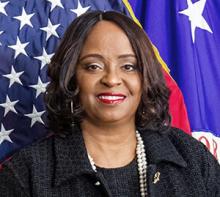
With $135 billion in annual capacity and a mandate lasting at least until 2026, EXIM is now reintroducing itself to American firms recovering from the pandemic — and to a world imposing new competitive pressures on U.S. companies, said Reta Jo Lewis, who was tapped by President Joe Biden to lead the 88-year-old organization. An attorney by training who grew up the daughter of small business owners, Ms. Lewis was confirmed by the Senate in February, become the first Black woman to lead the finance agency.
With supply chains shifting by the day, the Statesboro native and Emory Law graduate said the U.S. has ceded ground not only to potential adversaries like China, but also to friendly countries that maintained healthy export-credit agencies during EXIM’s self-imposed hiatus.
“America has to show up. We’ve been absent, and we no longer can be absent if we’re going to be in this global competition,” she said, alluding to the title of her talk at an Atlanta Council on International Relations luncheon: “Keeping America Competitive in an Intense Global Environment.”
“It is very intense. It is also exceptionally competitive. And I’m not just talking about those who we are in competition with. I’m also talking about those who we are actually allies and friends with,” said Ms. Lewis.
That said, she positioned the bank as reframing its partnership approach as a core element of its new face to the world.
In one example, EXIM is renewing co-financing agreements with friendly nations’ export credit agencies to pool risk for mutually beneficial projects, and it’s bringing a new sensibility to buyers in Africa, Latin America, Southeast Asia and beyond.
While EXIM is always focused first on its congressional mandate of growing American jobs, recent trips to launch a $500 million memorandum of understanding in Côte d’Ivoire and sign letters supporting a $3 billion nuclear plant in Romania have shown Ms. Lewis the importance of communicating that “we will not be a go-alone nation.”
“I tell all the leaders — it doesn’t matter what country I’m talking to — it’s not just about jobs in the United States. It’s also about jobs in their country,” she said. “No one wants you to come talk about “Our way or the highway.’ That day is dead. Everybody wants it to be a mutual opportunity. It’s about mutual respect. It is about the values that we share, but we want them to be working in partnership and collaboration.”
New Flexibility: Balancing Out China and Boosting Export-Oriented Manufacturing
A key priority for the bank is counterbalancing China, a notion that was built into EXIM’s reauthorization in 2019, even before COVID-19 set off a scramble to reevaluate strategic sourcing priorities around the world.
China is the juggernaut of export credit providers, dwarfing all others when it comes to support of its companies in global markets. In 2020, even as the cumulative amount backed by China’s three export credit agencies fell from $33 billion to $18 billion, the total was still 50 percent higher than the next closest competitor (France at $12 billion) and 10 times that of EXIM in the U.S. ($1.8 billion).
Couple this with the fact that China can offer more lax terms than the (mostly Western) countries inside the Organization for Economic Cooperation and Development, and what emerges is a recipe for losing deals in places where heady ideals like transparency in governance take a back seat to cheaper financing.
But EXIM has gained new flexibilty in its newest iteration, Ms. Lewis said, codifying that 20 percent of its capacity should go toward the China and Transformational Exports Program, or CTEP, which is expressly aimed at projects that can “neutralize” unfair Chinese subsidies.
Under CTEP, American companies in 10 strategic sectors can apply for special project-based financing to help fend off Chinese-backed challengers. The program covers semiconductors, biotechnology, artificial intelligence, quantum computing, renewable energy and other sectors that have garnered particular attention as Washington arrived at the uncomfortable consensus that the U.S. had become too reliant on one of its core competitors.
EXIM is also now plowing new ground by backing domestic facilities through the Make More in America initiative. While EXIM traditionally finances foreign purchases of U.S. products, in this instance its direct loans, guarantees and insurance products go directly to U.S. manufacturers expanding to meet export demand.
This does not suggest a relaxation in EXIM’s rigorous underwriting standards, which require due diligence to reach a “reasonable assurance of repayment” and assurances on environmental and labor practices, said Ms. Lewis.
“America has some of the best standards in the world, and that’s how we want to be judged. We’re not lowering our standards for anyone. It’s just not going to happen.”
Focusing on Africa and Small Businesses
In places like Africa, however, some have complained that EXIM’s zeal to protect American taxpayer dollars has left it with too dull of a risk appetite, harming its deal flow. (EXIM must maintain a delinquency rate of less than 2 percent, a constraint many agencies don’t face.)
In EXIM’s absence, Chinese agencies in particular have stepped in with competitively priced products and resource-backed loans U.S. legislators have panned as “debt-trap diplomacy,” though studies of Chinese involvement in Africa suggest the picture is somewhat more nuanced than many might admit.
In any case, Ms. Lewis said her conversations as she travels the globe are revealing more and more borrowers’ remorse among partner nations.
“A lot of these countries, not just in Africa, are moving away from those who they don’t believe have entered into agreements in a way that they should have entered into them or in the way that America would have entered into them,” she said, referring to China. “A lot of the products? Not working. Parts? Not there. Jobs? Absolutely not. I mean, I can go on and on. Rule of law? Not transparent. We are all of the above in the United States.”
Ms. Lewis spoke extensively about the opportunity in Africa, with a rich resource base and a billion (mostly young) buyers on a vast continent where most of the 54 countries boast rapidly growing populations paired with a dire need for infrastructure.
“We all know Africa is the last frontier — it’s where the critical minerals are, it’s where the consumer market is, and if we’re not playing, we just get left out,” the chair said.
Bolstered by the continent’s inclusion in the reauthorization, EXIM now has a team of 11 people focused on Africa within the bank, and Ms. Lewis followed up her trip to the recent COP27 conference in Egypt with meetings across the continent with finance and infrastructure ministers as well as elected officials.
EXIM has backed $176 million in environmentally projects this fiscal year, up from just $11 million in 2020, and its charter now calls for 5 percent of volume to go toward clean-energy, storage or battery projects.
EXIM’s plans to get back to full strength will rely on grassroots support from companies and economic development agencies in places like Georgia, which she cited as an exemplar when it comes to growing global trade.
“We cannot be the EXIM of old; we have to be the EXIM of new, and being the EXIM of new means more partnerships, more collaboration,” she said, adding that 30 percent of EXIM capacity should now be devoted to small companies.
“This is the era where EXIM has to be the bank of everybody,” Ms. Lewis told Global Atlanta in a post-event interview, framing the bank’s actions within the Biden effort to enact a “foreign policy for the middle class.”
“This is the era where EXIM has to be the bank of everybody.”
reta jo lewis
EXIM’s partnership approach is leading to deeper ties with sister agencies in Washington and embassies abroad, as well as further conversations with city, county and state governments, said Ms. Lewis, who ran an intergovernmental initiative at the State Department under the Obama administration before joining The German Marshall Fund of the United States, where she served as director of congressional affairs immediately prior to joining the bank.
EXIM is also turning to its larger clients to find bankable small companies upstream in their supply chains. Only by tapping into more of small businesses among the estimated 300,000 exporters across the nation can EXIM get the “diversification” its new mandate calls for, Ms. Lewis said.
War-ravaged Ukraine, she added, will be a prime target for projects that will help rebuild using American products and knowhow, building on an EXIM legacy that includes post World War II reconstruction in Europe.
“It’s going to be specific, project by project. They’ve got some immediate needs, and the team internally is looking at that, to be very much aligned with the administration to try to help the Ukraine citizenry any way we can.”