


Even as they deal with a maze of restrictions, new safety protocols and uncertainty about their own operations, manufacturers across Georgia, many of them with foreign parent companies, have found ways to step up and fight the COVID-19 pandemic within the state and beyond.
Some in Washington have criticized President Trump for only recently using his powers to compel manufacturers to churn out medical supplies such as ventilators or increasingly scarce personal protective equipment like masks, face shields and gowns.
But few manufacturers locally have waited for orders from the top, instead mobilizing through industry associations or chambers of commerce that have become indispensable venues for collaboration during the fast-paced response.
In just the first five days after specialty orders started coming in, Korean-owned plastic film producer SKC had produced enough square footage for millions of face shields at its plant in Covington, Ga., about 35 miles east of Atlanta.
“We’re pretty much wide open based on the emergency calls that came in last minute,” said Tom Gray, vice president of operations.
SKC had planned to take two weeks of downtime in mid-March, but an influx of orders cut that to one and forced a quick reorientation of production lines. Some 60 percent of the plant’s 300 workers, including office staff, are now at home, and engineers have been alternating weeks in the office to comply with social distancing guidelines.
“There’s no playbook for this, and we’ve been following the CDC’s recommendations, but we’re also manufacturing, so we’re trying to figure out what the best practices are,” Mr. Gray said, adding that webinars from groups like Georgia’s Next Generation Manufacturing have been helpful.
A “skeleton crew” continues to operate machines that churn out giant rolls of plastic film of various thicknesses. SKC’s catalogue includes films for food packaging, medical imaging, window tinting and more. But the bulk of production now is going to thicker, sometimes-layered plastic to be fashioned into face shields.
Mr. Gray said the first orders were existing clients, but the factory started getting calls from other firms retooling their factory floors to join in the fight.
“It’s the full gamut of customers across the U.S.,” Mr. Gray said. TSG Resolute, an Americas-based supplier of gaskets and thermal insulation, is one firm that has been recognized by the state for allocating factory space toward face shields.
Georgia Tech also requested SKC material, as researchers used 3D printing and the laser cutting machines to make a first batch of 10,000 shields before partnering with local companies to increase the scale. Coca-Cola Co. brought three tons of plastic sheeting to Georgia Tech’s campus to be made into 50,000 shields. Siemens, the German giant that operates a Georgia Tech innovation center, has also committed to working with the university to make 25,000 face shields that will be distributed to hospitals by the Georgia Emergency Management Agency.
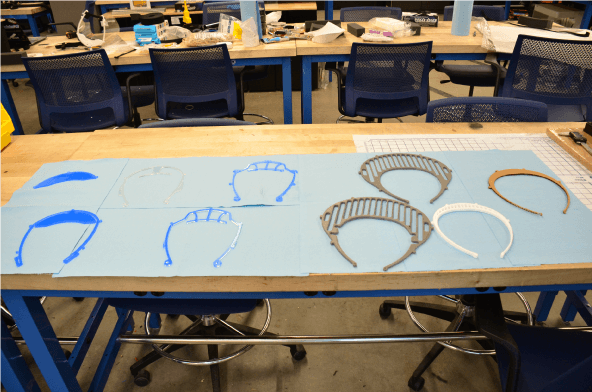
Delta Air Lines Inc. also stepped up, offering team members and space from its Delta Flight Products facility to make face shields with materials and designs from the Global Center for Medical Innovation, a nonprofit affiliate of Georgia Tech that incubates new medical devices. The first run of 2,000 shields went to New York, while 4,000 would be made available to Atlanta-area hospitals, Delta said.
Meanwhile, Japan-owned YKK Corp. of America, based in Marietta with multiple factories in Georgia and around the U.S., was pulled into making PPE through a relationship far beyond state borders.
As Ford Motor Co. began to make ventilators and face shields in Michigan, it looked down its supply chain for help. YKK, which supplies parts and zippers to the automotive industry, called upon Tape Craft, an Alabama subsidiary, to supply elastic straps.
“Within two days, we were able to start changing the way we were doing things to provide 85,000 of those,” Jessica Cork, vice president of communications, said during a Japan-America Society of Georgia teleconference last week.
When supply chain interruptions brought on an elastic shortage, Tape Craft and YKK’s R&D team conferred to find other solutions. Among them were hook-and-loop fasteners and cord stoppers made in Macon, attached with plastic buckles.
Elsewhere in the YKK system, the company known for its zippers continues to supply government contractors making hazmat suits and portable isolation wards. It’s also making fastening products for medical masks, hospital gowns and beds in partnership with apparel firms that have reoriented their factories during the crisis.
Mike Todaro of the Americas Apparel Producers Network said that a similar shift has taken place quickly among his association’s members.
The Atlanta-based network, which works with hundreds of apparel factories across the Western Hemisphere, opened its internal sourcing database to competing associations on March 22. By that night, it had been viewed 800 times, and since then it has garnered 10,000-plus views.
“When this crisis hit, we said we needed to start seeing who knows how to make medical products, and we can’t do it by email,” Mr. Todaro told Global Atlanta. “Now we have about 500 companies that aren’t members that are interacting on this thing.”
Some tangible collaborations have emerged. A uniform manufacturer used the network to source 50,000 yards of specialty fabric to make medical gowns for Emory University hospital. A manufacturer of complex labels for pants is using its machines to make 100,000 masks, also for Emory.
“These are good people that trust us in saying, ‘Hey, we need help,’” Mr. Todaro said. Another member, software and machinery provider Gerber Technology, has brought together 600 suppliers, many of them also AAPN members, into a global PPE task force that has made sewing templates and best practices available online.
Other Georgia manufacturers have begun to donate products that are less salient to frontline work but show solidarity with health care workers while shoring up their own businesses.
For every order on its website during the crisis, Okabashi Brands is donating a pair of shoes made in Buford to a health care provider, up to 10,000 pairs. Atlanta’s King of Pops is raising $30,000 via GoFundMe to provide 10,000 popsicles to health workers as its business reels form evenet
All this comes as other many plants have had to close down, furloughing or laying off workers as demand has fallen or shelter-in-place orders have rendered them “non-essential.” In all sectors, Georgia has handled 400,000 jobless claims in the last week, reportedly more than in all of 2019.
Some of Georgia’s largest foreign-owned plants have shut down temporarily, either due to demand issues or Covid-19 cases among their workers, but most hope to ramp back up before they’re forced to lose staff. Labor was already in short supply before the crisis hit, and some fear that separating from skilled operators would hamper recovery when orders start to roll back in.
TOTO USA has been paying its staff in McDonough during a two-week closure scheduled to end April 13, said Bill Strang, president of operations and e-commerce for the Japanese subsidiary.
“We do not want to lose those skilled resources and that skilled labor — we want to make every effort, as long as this goes, to make sure they know they have a job,” he said during the Japan-America Society call.
Some Georgia-based companies, meanwhile, have seen their geographic and product diversification pay off during this tough time.
Atlanta-based East West Manufacturing has enacted measures to preserve cash, cutting executive salaries and halting acquisitions, but it hasn’t had to shut down any of its plants in Vietnam, China, Costa Rica or four in the U.S.
“We were really worried initially about having to lose customers and having to shut down for facilities. Fortunately through this we’ve recognized that we make a lot of important products,” said CEO Scott Ellyson.
Half of East West’s clients, representing about 90 percent of pre-crisis revenue, have continued to operate as “essential” businesses, showing the value in East West’s move toward high-tech products that make the world “cleaner, healthier, safer and smarter.” Those range from parts for Amazon’s warehouse robots to systems that filter hospital air or control blood gas monitors.
“For the moment, our pipeline is strong,” Mr. Ellyson said, acknowledging East West would likely not reach its ambitious goal for 30 percent growth this year. Its acquisition spree is on hold, and makers of capital goods will be harmed when inevitable post-crisis belt-tightening occurs, he said.
“I also expect that we are going to find that some of our customers don’t make it.”
Georgia companies aiming to contribute to the production and distribution of critical supplies are asked to sign up with the Georgia Department of Economic Development through this form, which includes a list of requested gear.