


Green Worldwide Shipping is the presenting sponsor of Global Atlanta's Trade Channel. Sign up here for monthly global trade updates.
The stars have aligned for Georgia’s relationship with Peru. Or perhaps a more fitting analogy — seeds sown with the South American country over time have now begun to bear fruit.
That was the consensus among panelists at the latest installment of Latin American Crossroads, a Global Atlanta series of news reports and live events showcasing the city’s role as a business hub for the Western Hemisphere.
Sponsored by Emory Executive Education at Emory University’s Goizueta Business School, the May 30 event honed in on ports, produce and pisco, Peru’s national spirit, showing how deepening agricultural trade has created inroads for Georgia there.
Peru’s economy for past 15 years has grown at nearly 6 percent annually on average, an impressive run unrivaled in many places in the world. The country followed its southern neighbor Chile’s lead in using the windfall of a copper boom to buy time for more global integration.

Peru now is a member of the Pacific Alliance, a trading bloc also including Mexico, Colombia and Chile. It’s also part of the post-U.S. Trans-Pacific Partnership, an 11-country pact, and has had a free-trade deal with the U.S. for about a decade.
After cutting poverty rates in half from 51 percent to 23 percent, the country now aspires to become member of the Organization for Economic Cooperation and Development, a club of relatively rich countries.
“We stil have a long way to go,” Consul General Miguel Aleman said in opening remarks at the event, but it’s hard to argue with a growing middle class that’s beginning to travel the world.
Onions: From Vidalia to Arequipa
As Peru quietly grew, Georgia farmers figured out that they could do more than just export wood pulp, cotton peanuts and blueberries. By heading south of the equator, they could tap into a whole new growing season, supplying markets back home with the crops customers were used to, but more affordably and on a year-round basis.
The first to figure it out were Vidalia onion farmers, who found a off-season climate in southern Peru that somewhat mimicked conditions in south Georgia. And they had ready regional access through the Port of Savannah, which was starting to wake up to a trade imbalance caused by Georgia’s massive poultry industry.
“We were exporting a thousand containers a week of Georgia poultry all over the world, and we were trying to drive some balance, some equilibrium,” Georgia Ports Authority Senior Director of Trade Development Chris Logan said of the effort to win agricultural business from South America.
Onions were one of the few crops that didn’t run afoul of U.S. Department of Agriculture regulations keeping certain fruits from entering Southern ports.
“Savannah is well known. We get about 50 percent of all the Peruvian onions that are imported into the United States,” Mr. Logan said.
Meanwhile, more produce is starting to trickle in thanks to evolving USDA regulations. Crops like blueberries and grapes from Peru, Chile and Brazil must be cold-treated to kill damaging fruit flies. To be extra safe, the U.S. previously required them to be imported via northeastern ports where it was too cold for flies to live if a single one escaped. The added time made it slower to get Peruvian produce on Southern shelves.
A pilot program, however, has helped Savannah and other ports begin taking more Peruvian fruit that is cold-treated either in transit or after docking at the port.
“We’re really excited about the exponential growth that we continue to see out of Peru from an agricultural standpoint,” said Mr. Logan, who is set to travel to Peru again in July.
Decades of Trade
The export story from Georgia to Peru goes far beyond the humble onion. Kamin LLC has been doing business in the country for 30-plus years, exporting its fine kaolin clay from mines and factories in Middle Georgia to a Peruvian distributor.
Kaolin isn’t necessarily an easy sell: It’s used in everything from paper to paint, plastic, ink, adhesives and more. The Macon-based company lucked into a partner who knew the ropes in their local market.
“We’ve not had any issues with logistics, with payments, and quite honestly we take the success we’ve had in Peru as a model when we look to expand into other areas,” says Robbie Cowsert, head of global industrial sales for the company.
For those without decades-long relationships, the Georgia Department of Economic Development can help, says Mary Waters, deputy commissioner for international trade.
The state announced in March that Peru would be the 12th country to house a Georgia trade office. The announcement came coincidentally on the same day Peruvian President Pedro Pablo Kuczynski stepped down over his alleged role in a corruption scandal, but that hasn’t slowed momentum, Ms. Waters said.
In April Georgia companies AdEdge Technologies, CocoaTown and others got to meet the state’s rep there while traveling to Peru, Colombia and Chile on state-led trade mission that culminated with the Expomin mining show in Chile.
Georgia picked Peru for its newest office in part because the Chile office was up for grabs, and the winning company also had a Peruvian presence.
But even the parameters of the bid were strategic in that aspect, party because Georgia companies were asking for it.
“As companies become more savvy at their business development strategy in Latin America, they’re saying, ‘Now we need Georgia to have a representative that has my back in Peru as we go into that market,’” Ms. Waters said. More on the Peru-Chile offices here
Luis Felipe Segura, a director in Atlanta for PwC, believes Peru is a major opportunity.
Mr. Segura has spent a combined 18 months or so in the country over a 17-year period with PwC, working on deals with in telecommunications, mining and beyond.
Things have drastically shifted since he first started going; now Peru trails only Mexico in the World Bank’s Doing Business rankings for Latin America.
“Over the years I have seen a tremendous change, to the point where I don’t think they’re behind Mexico anymore. At least in Lima, the business environment is equal to Mexico,” he said.
Importantly, he said, Peru ranks better on Transparency International’s corruption perception index, No. 96 to Mexico’s No. 135.
Watch out for pharmaceuticals as a major growth sector and for the intensity of food exports to grow, Mr. Segura said.
The consul general, Mr. Aleman, also gave concrete ways to be involved in Peru’s growth.
“Peru has an infrastructure gap of more than $60 billion — ports, airports, highways — for the next 25 years, so that is also a very important area where we can have economic cooperation,” said Mr. Aleman.
The event closed with three presentations on art, education and entrepreneurship in Peru.
Stan Mullins, an Athens, Ga.-based artist who has become somewhat of a cultural ambassador for the arts around the world, recently visited Peru and participated in an impromptu exchange arranged in part by Mr. Aleman.
Mr. Mullins met in Lima with Victor Delfin, a famous artist responsible for “El Beso,” or the “The Kiss,” a famous sculpture in the Miraflores region of the city.
Mr. Mullins is working on a 17-foot bronze statue of Yamacraw chief Tomochichi, who welcomed the founders of the Georgia colony near what is now Savannah. He and Mr. Delfin traded thoughts on the history of indigenous peoples in their respective regions.
“Art is the most lasting currency we have,” Mr. Mullins said at the business-focused event, presenting Mr. Aleman with a Tomochichi print signed by Mr. Delfin.
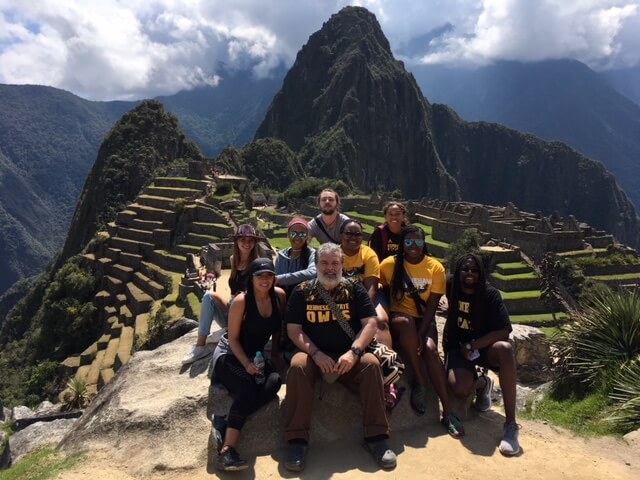
Ernesto Silva, a professor at Kennesaw State University, discussed a Latin American studies tour of southern Peru inspired in part by the university’s Year of Peru in 2011, of which Mr. Silva was an integral organizer.
Giannina Bettis introduced her company, Peruvian Stamp, which takes Peruvian fabrics and incorporates them into designs for purses sold in the U.S. A portion of the proceeds goes to help underprivileged children.
The Georgia Hispanic Chamber of Commerce was a supporting sponsor for the event, which also drew members of the Association of Latino Professionals for America.

The Pendleton Group is the presenting sponsor of Global Atlanta's Economic Development Channel. Subscribe here for monthly Economic Development newsletters.