


Former U.S. Ambassador Charles Shapiro is very clear about one thing when it comes to the Cuba trip he’s leading in June: Travel with him, and you don’t have to worry about the U.S. Treasury Department knocking on your door.
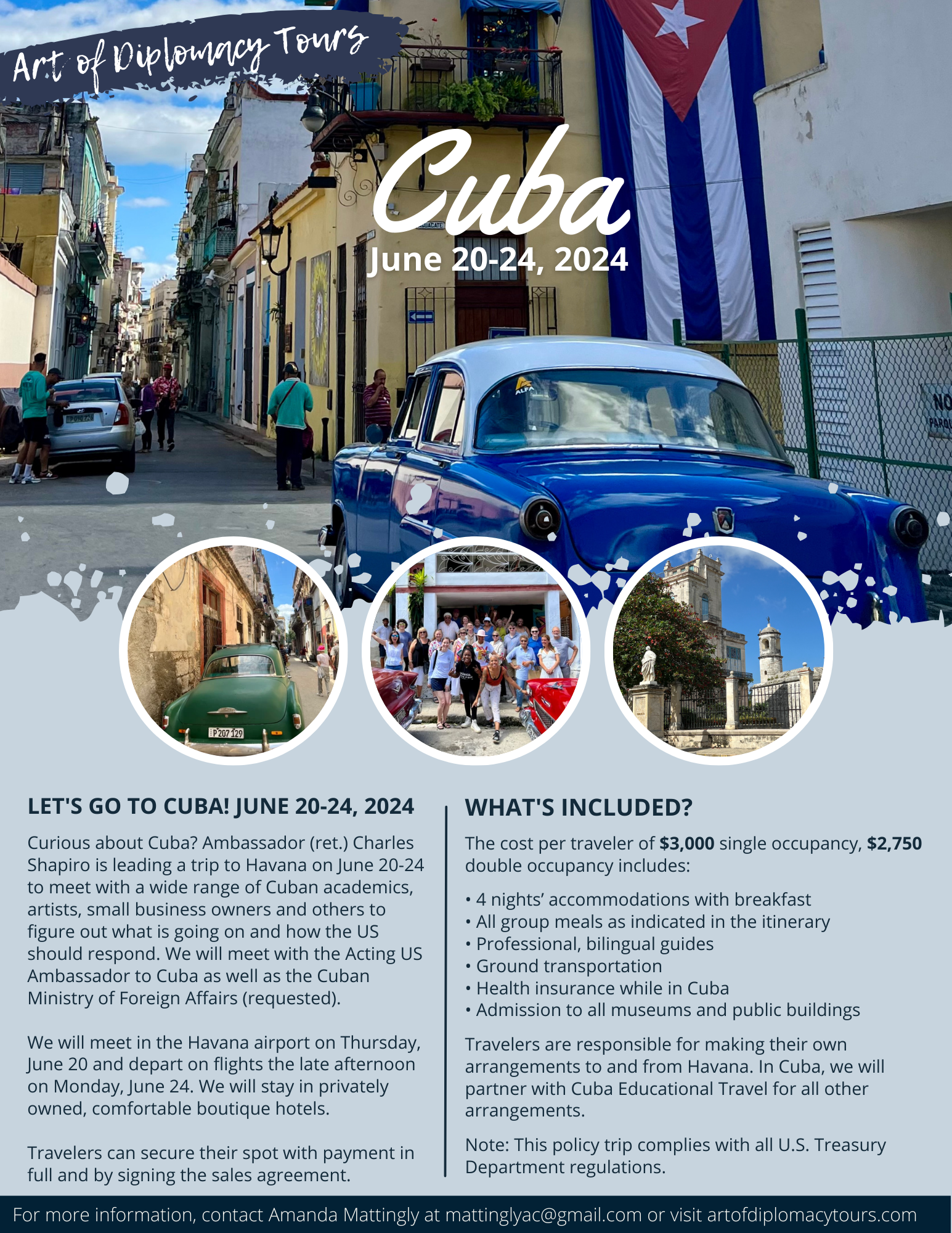
Due to the longstanding U.S. embargo, the island nation remains closed off to Americans, with exceptions for humanitarian, diplomatic or educational trips.
The latter is what Mr. Shapiro’s Atlanta-based outfit, Art of Diplomacy Tours, is set to provide to participants, along with deep cross-cultural immersion over an extended weekend June 20-24.
“It is fascinating. Truth be told, the educational part is very cool,” said Mr. Shapiro, who says participants will be provided all the right documentation to show their trip is above board. “We’re doing exactly the sort of thing that the law was set up to encourage people to do.”
Compliance is by far the least compelling part of the packed five-day trip.
The itinerary features dinner at the U.S. ambassador’s residence and meetings with the Cuban foreign ministry. The program provides an intensive look at Cuban art, culture and entrepreneurship, featuring engagements with a female Cuban hip-hop duo, a dance troupe and a couple who work to keep Cuba’s iconic classic cars on the road. Breakout meetings will bring travelers into contact with local experts on health care, education and religion. All appointments are interspersed with cultural experiences and meals at private restaurants.

“It’s jammed full with as broad a cross-section of Cuban society as we can come up with,” said Mr. Shapiro, who undertakes the tours with Amanda Mattingly, another former diplomat based in Atlanta.
Cuba Educational Tours provides on-the-ground logistical support including local guides, while Mr. Shapiro lends his connections and insight on the Americas.
Still Relevant
While Cuba has faded from the headlines since the days of the Cold War and even from the attempted rapprochement of the Obama administration a decade ago, Mr. Shapiro, a former ambassador to Venezuela and president of the World Affairs Council of Atlanta, said there’s much of modern-day relevance to learn about an island that for many is still shrouded in mystery.
Having traveled to the country some 15 times since 1998, Mr. Shapiro has seen Cuba change, and not always for the better.
While individual Cubans always display resilience and creativity, policies enacted by the Communist government continue to weigh on an economy still dependent on tourism.
Cuba, Mr. Shapiro said, is in the midst of a brain drain, with an estimated half-million of its 11 million citizens having left the country in the last few years.
“The people who leave, of course, are people who tend to be under-30 university grads from Havana. They are the people who are the future of the country, essentially.”
Cubans are being found among the surge of migrants at the southern U.S. border, he added. They travel visa-free to Nicaragua, make their way across Central America and Mexico and plead asylum with U.S. border agents. A lengthy backlog means it often takes years to adjudicate individual cases, allowing many Cubans to take advantage of a 1966 law that provides green cards to Cuban-born citizens after a year in the U.S.
Reports like this, and news that Cuban mercenaries are fighting for Russia in Ukraine, shows how Cuba’s influence on the U.S. goes beyond its impact on swing-state elections, he added.
“We and Cuba are neighbors — an oil spill in Cuba ends up on the beaches in Florida. Ninety miles is nothing in terms of climate and pollution and everything else,” he said.
Experiencing History, Embracing Complexity
Beyond this, Cuba is simply fascinating in its own right, Mr. Shapiro said. Old Havana is a UNESCO world heritage site where the Spanish landed 100 years before the pilgrims hit North American soil, and the country boasts a rich Afro-Caribbean history due to the enslaved people brought to work an island that was once the most prolific sugar producer in the world. (In an ironic twist, now imports the commodity, along with chicken from Georgia and other U.S. states taking advantage of a carveout for food products in the embargo).
“You can almost see people’s minds opening up when they realize how rich the history of Spanish America is,” Mr. Shapiro told Global Atlanta.
The cost of the trip is $3,000 for single occupancy or $2,750 for double. The group will stay at privately owned boutique hotels to avoid patronizing the Cuban military, which owns the majority of the country’s hotels.
That’s just another example of how Cuba defies easy encapsulation, challenging visitors to consider the nuances of international relations.
“Cuba is too complicated to describe in a soundbite,” though politicians on both sides of the “hyper-partisan divide” in the U.S. oversimplify things for their own political ends, Mr. Shapiro said. Hopefully not so for those who return from an Art of Diplomacy tour, he added.
“What I hope people take away is a sense for how complex the situation is.”
Airfare to the island is not included, and visas are required.
For more information or to sign up, email Amanda Mattingly or visit www.artofdiplomacytours.com
Download a sales sheet with logistical details here and read the proposed itinerary below:
ArtofDiplomacy-Cuba-Program-June-2024