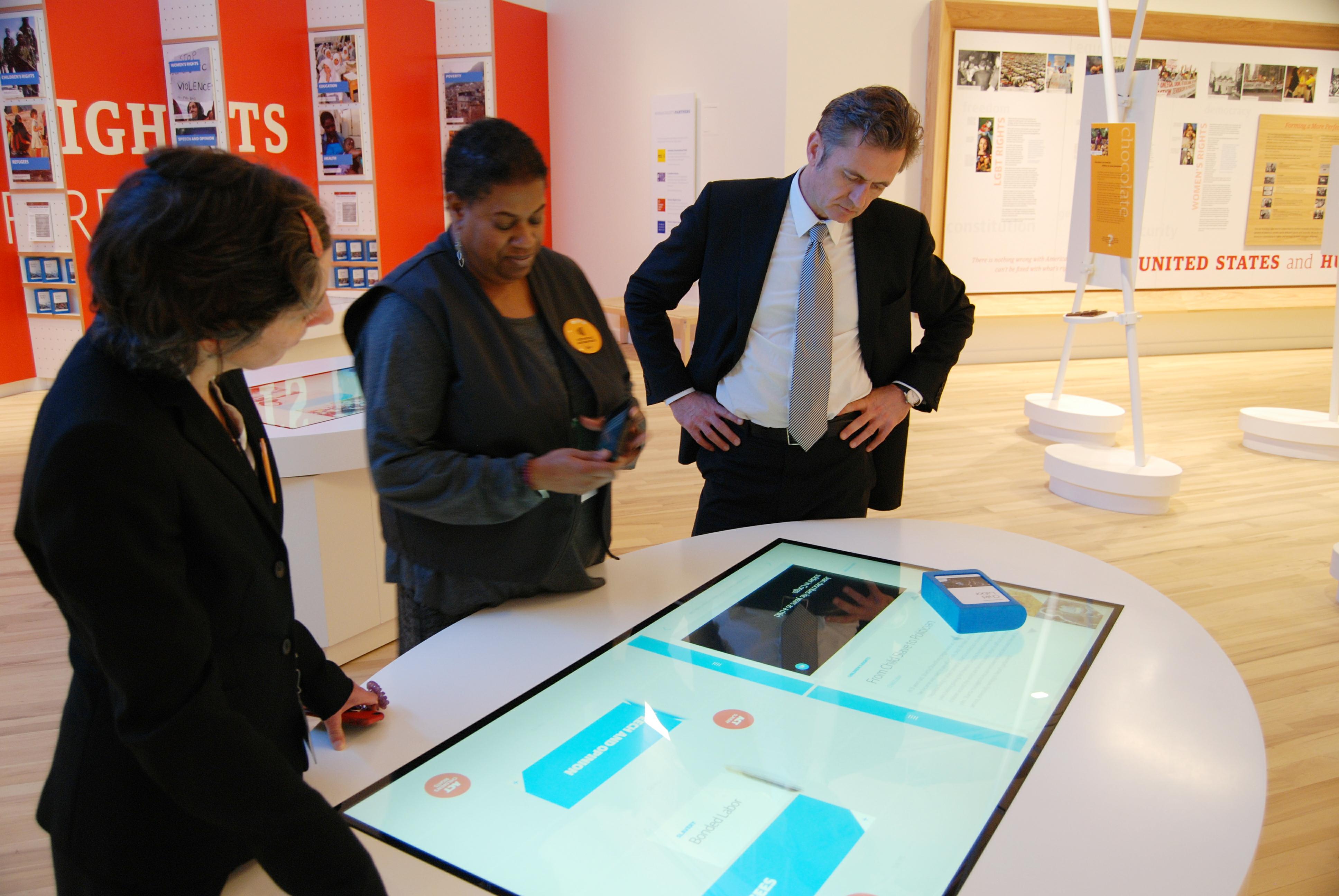
Atlanta’s National Center for Civil and Human Rights is a bold advocate for the values embodied in its name and assumes an important role in the face of the “huge challenges in the world right now,” Liechtenstein’s permanent representative to the United Nations, told Global Atlanta during a visit here Nov. 19.
Ambassador Christian Wenaweser referred in an interview preceding his appearance at the center to challenges such as striking a balance between security and human rights or stopping the refugee relocation programs.
Concerning human rights, “It’s important to stand up when there is resistance and people feel strongly in different ways,” he said.
Mr. Wenaweser came to Atlanta directly from his post at the U.N. in New York amidst the discussions surrounding French President Francois Hollande’s declaration of war on the Islamic State of Iraq and Syria (ISIS).

He had been invited to Atlanta months earlier by Dr. Bruce Allen, the honorary consul of Liechtenstein based in Georgia, before the most recent acts of violence perpetrated by ISIS.
Mr. Wenaweser said that the mood of the U.N. at the time of the Paris attacks reminded him of the intense atmosphere following the Sept. 11, 2001, attacks in New York and Washington.
When appointed as his country’s Permanent Representative in 2002, the U.N. was filled with controversy over the possible military intervention in Iraq, which the U.S. didn’t lead until March of 2003.
“It was (like) the time of the build up to the intervention in Iraq,” he said. “In some ways it was different, but also similar to the place where we find ourselves today.”
Following his return to New York on Nov. 20, the five voting members of the U.N.’s Security Council — the United States, the United Kingdom, France, China and Russia — unanimously supported a resolution calling on countries to take “all necessary measures” to fight ISIS in Syria and Iraq.
In its resolution, the council stated that ISIS “constitutes a global and unprecedented threat to international peace and security” and condemned the “horrifying terrorist attacks” in Paris which left 130 dead as well as atrocities committed by ISIS in Tunisia, Turkey, Lebanon and the downing of a Russian passenger plane over Egypt.
In this case, and in contrast to the legal wrangling following the Sept. 11 attacks, the Security Council sidestepped focusing on the pure legality of taking the fight against ISIS in order to unanimously denounce its actions.
Mr. Wenaweser made it clear in the interview where Liechtenstein stood concerning ISIS’s attacks, perhaps indicating that he suspected what would be the conclusion of the upcoming vote.
“I represent my country and the views of my country,” he said. “We have a foreign policy strongly based on rule of law and human rights. We take a very legal view of things, but in this situation we are standing closely with friends and allies in Europe. ISIS is a threat against all of us…not just against France.”
As one of the smallest countries in the U.N. and despite its efforts to broaden the number of members in the Security Council, he underscored Liechtenstein’s support of the U.N.’s charter.
“Sovereign equality is a founding principle of the U.N. charter,” he said, “small states are therefore in a good place to play a good role at the U.N.”
A realist, he acknowledged, however, that as a principality composed of only 62 square miles with a population under 50,000, its ability to act on the world stage is limited. Liechtenstein doesn’t even have an army, which it abolished in 1868 due to a lack of funds.
But as an example of a proactive role the country can play, he described his responsibilities as president of the Assembly of State Parties of the International Criminal Court, a U.N. body that is mandated to bring to justice perpetrators of war crimes against humanity and genocide.
The court was established by a treaty known as the Rome Statute adopted at a diplomatic conference in Rome in 1998. As of this year, 123 states are party to the statue that established four core international crimes: genocide, crimes against humanity, war crimes and crimes of aggression.
In 2010, when Mr. Wenaweser was president of the court, a conference was held in Kampala, the capital of Uganda, to determine the conditions under which the court could exercise jurisdiction on grounds of a crime of aggression having been committed.
The Uganda site was chosen particularly because many of the cases to be brought to the international court involved African cases including those from the Democratic Republic of the Congo, northern Uganda, the Darfur region of Sudan, the Central African Republic and Kenya.
Under the Rome Statute, the court can only investigate and prosecute the applicable crimes in situations where states are “unable” or “unwilling” to do so themselves. It also applies only to signatories of the statute, which does not include the United States, but does include many African countries.
Mr. Wenaweser said that he considered leading the process to define the seven acts that constitute a crime of aggression as his greatest accomplishment at the U.N. Click here for the list.
Dr. Allen told Global Atlanta that the ambassador received a warm reception at the center’s sold out dinner where both Gov. Nathan Deal and Atlanta Mayor Kasim Reed had prepared welcoming remarks.
The governor’s comments observed that the center “reminds us how far we have come with regard to civil rights and how far the world has to go with regard to human rights.”
The mayor also referred to the center as having a global mission, connecting “the American Civil Rights Movement to today’s Global Human Rights Movements.”

The Dean Rusk International Law Center at the University of Georgia is the presenting sponsor of Global Atlanta's Diplomacy Channel. Subscribe here for monthly Diplomacy newsletters.